Sree Narayana Institute of Technology

Email

info@snit.edu.in

Phone

04734-244600 | 244700 | 244900

Institution Code

SNP | P06

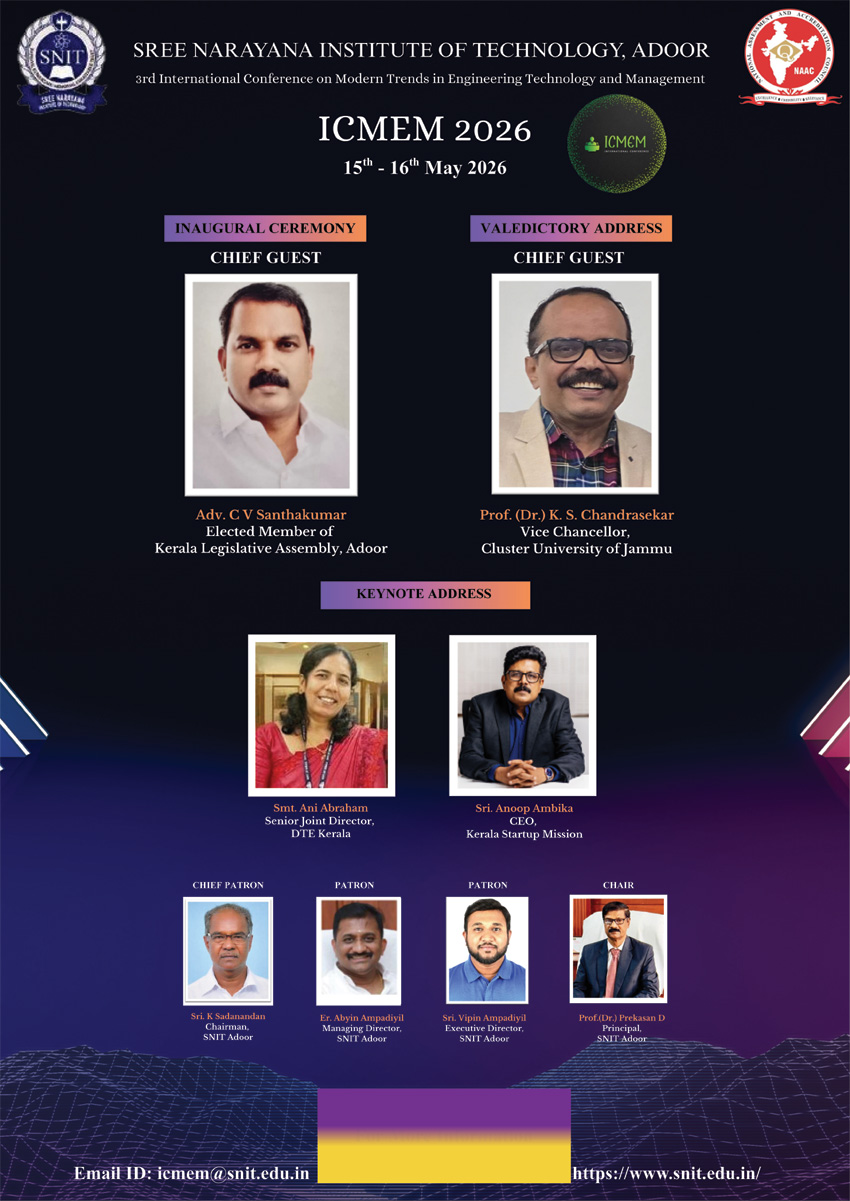
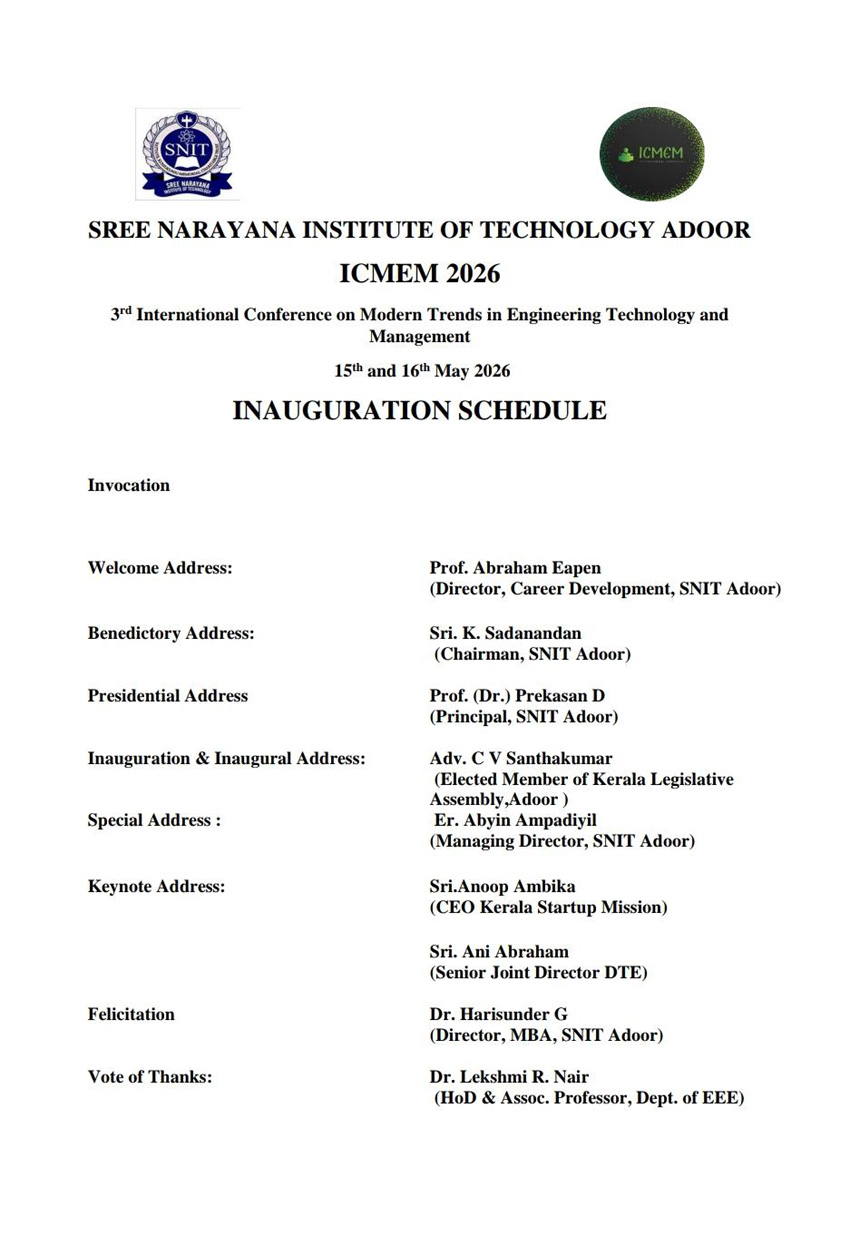
ICMEM 2026

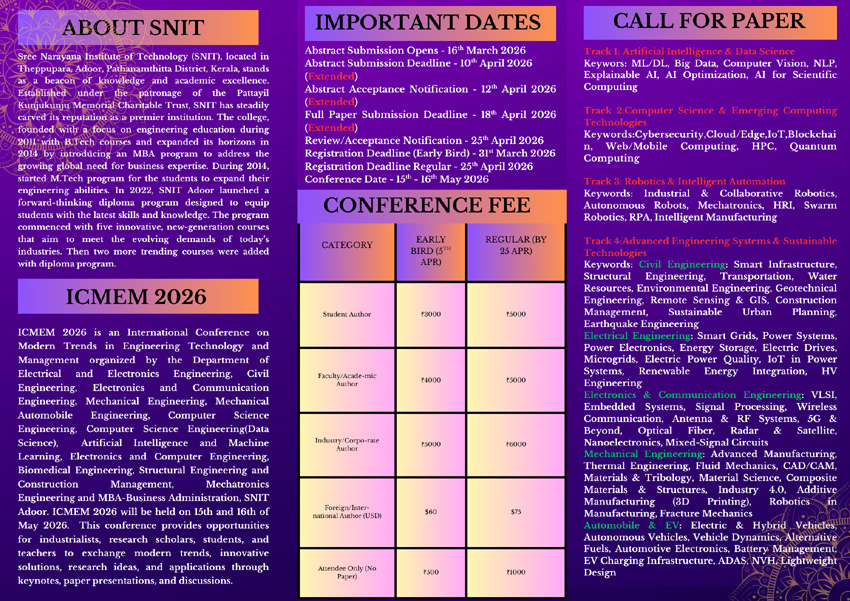
International Conference on Modern Trends in Engineering Technology and Management

CONFERENCE GUIDELINES

15–16 May 2026 | Sree Narayana Institute of Technology, Adoor

ICMEM 2026

1. Conference Overview

ICMEM 2026 is an international academic conference that brings together researchers, engineers, academicians, and industry professionals to present and discuss the latest innovations and emerging trends in Engineering and Management.
The conference focuses on the convergence of Artificial Intelligence, Robotics, Computer Science, Core Engineering, and Management disciplines to foster intelligent automation, digital innovation, and sustainable technological advancement.

2. Conference Coordination Committee Structure

2.1 ICMEM 2026 Conference Coordination Committee (CCC)

The Conference Coordination Committee (CCC) is formed with one faculty representative from each department. This committee serves as the primary institutional body responsible for organizing and coordinating all conference activities.
Department CCC Representative
Computer Science & Engg.
Ms. Lekshmi Rajan
Electronics & Communication
Ms. Lekshmi Raj R.
Mechanical Engineering
Mr. Ajmal N
Mechanical Engineering (Automobile)
Mr. Akhil R
Civil Engineering
Ms. Reshma C
Electrical & Electronics Engineering
Dr. Aruna N S
Basic Sciences
Ms. Archana R
Management Studies (MBA)
Dr. Rejani R K Nair

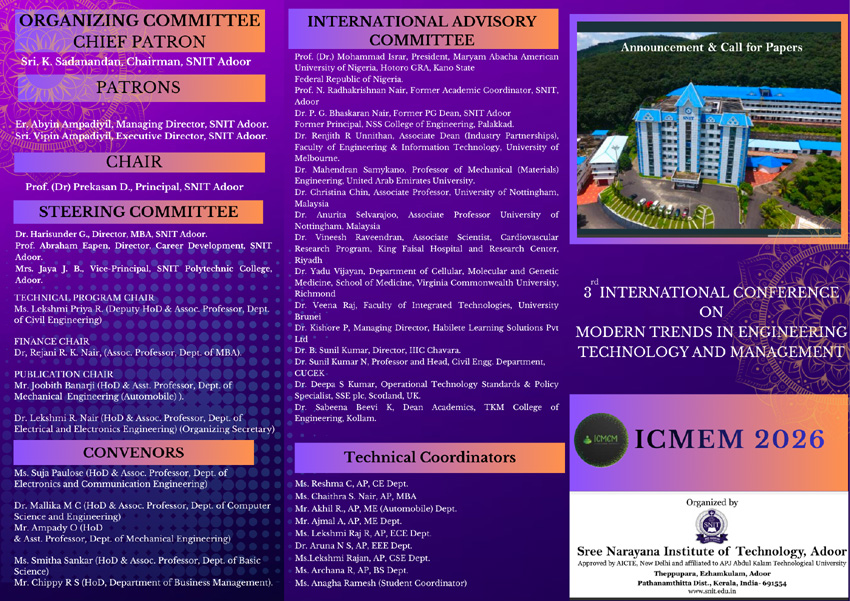
2.2 Organizing Committee

Role Responsibility
Chief Patron
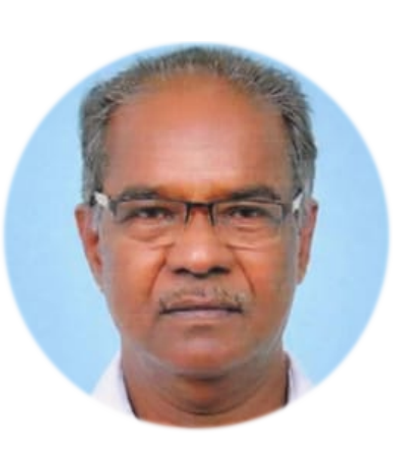
Sri. K. Sadanandan, Chairman, SNIT, Adoor
Patron
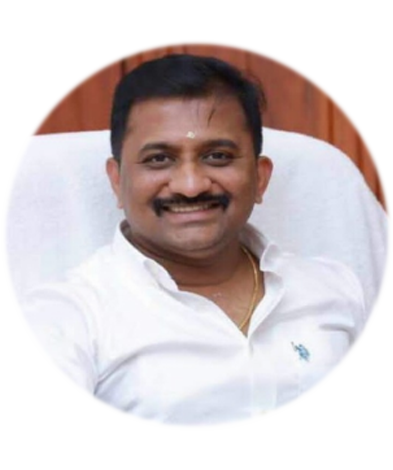
Sri. Abyin Ampadiyil, Managing Director, SNIT, Adoor
Sri. Vipin Ampadiyil, Executive Director, SNIT, Adoor
Chair
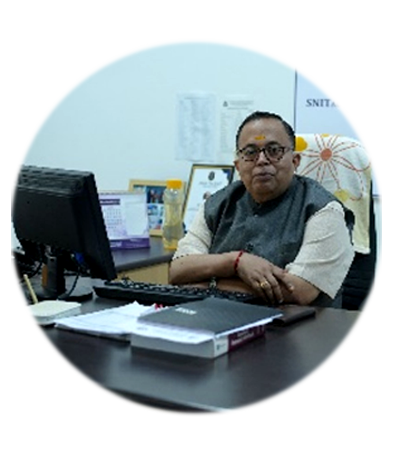
Prof. (Dr.) D. Prakasan, Principal, SNIT Adoor
Organizing Secretary
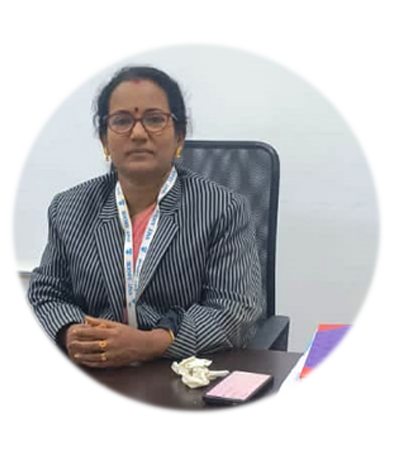
Dr. Lekshmi R Nair
CCC Coordinator
Dr. Lekshmi R Nair
Technical Program Chair
Ms. Lekshmi Priya R
Finance Chair
Dr. Rejani R K Nair
Publication Chair
Mr. Joobith Banerjee

3. Conference Tracks

ICMEM 2026 is organized into six main technical tracks. Authors must select the most appropriate track during submission.
Track Track Name Key Topics
Track 1
Artificial Intelligence & Data Science
ML/DL, Big Data, Computer Vision, NLP, Explainable AI, AI Optimization, AI for Scientific Computing
Track 2
Computer Science & Emerging Computing Technologies
Cybersecurity, Cloud/Edge, IoT, Blockchain, Web/Mobile Computing, HPC, Quantum Computing
Track 3
Robotics & Intelligent Automation
Industrial & Collaborative Robotics, Autonomous Robots, Mechatronics, HRI, Swarm Robotics, RPA, Intelligent Manufacturing
Track 4
Advanced Engineering Systems & Sustainable Technologies
Civil Engineering: Smart Infrastructure, Structural Engineering, Transportation, Water Resources, Environmental Engineering, Geotechnical Engineering, Remote Sensing & GIS, Construction Management, Sustainable Urban Planning, Earthquake Engineering
Electrical Engineering: Smart Grids, Power Systems, Power Electronics, Energy Storage, Electric Drives, Microgrids, Electric Power Quality, IoT in Power Systems, Renewable Energy Integration, HV Engineering
Electronics & Communication: VLSI, Embedded Systems, Signal Processing, Wireless Communication, Antenna & RF Systems, 5G & Beyond, Optical Fiber, Radar & Satellite, Nanoelectronics, Mixed-Signal Circuits
Mechanical Engineering: Advanced Manufacturing, Thermal Engineering, Fluid Mechanics, CAD/CAM, Materials & Tribology, Material Science, Composite Materials & Structures, Industry 4.0, Additive Manufacturing (3D Printing), Robotics in Manufacturing, Fracture Mechanics
Automobile & EV: Electric & Hybrid Vehicles, Autonomous Vehicles, Vehicle Dynamics, Alternative Fuels, Automotive Electronics, Battery Management, EV Charging Infrastructure, ADAS, NVH, Lightweight Design
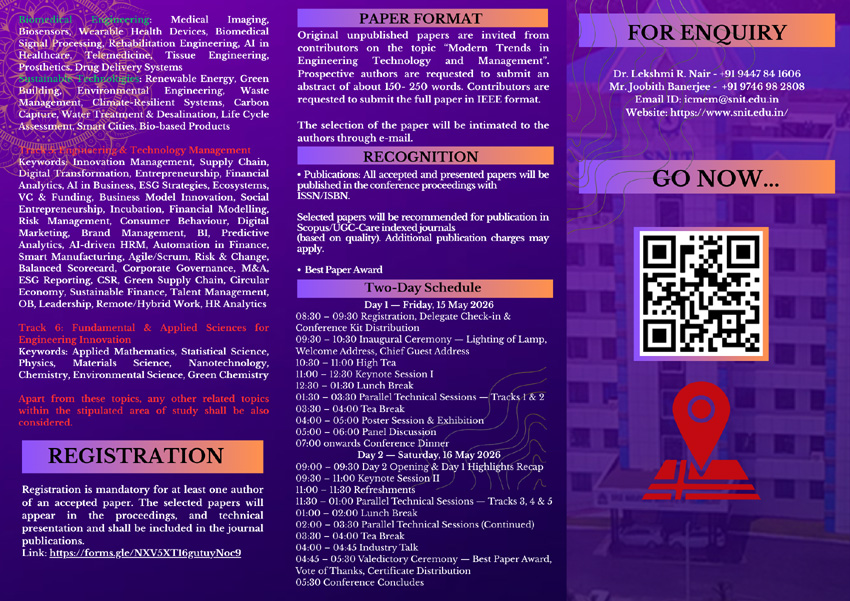
Biomedical Engineering: Medical Imaging, Biosensors, Wearable Health Devices, Biomedical Signal Processing, Rehabilitation Engineering, AI in Healthcare, Telemedicine, Tissue Engineering, Prosthetics, Drug Delivery Systems
Sustainable Technologies: Renewable Energy, Green Building, Environmental Engineering, Waste Management, Climate-Resilient Systems, Carbon Capture, Water Treatment & Desalination, Life Cycle Assessment, Smart Cities, Bio-based Products
Track 5
Engineering & Technology Management
Innovation Management, Supply Chain, Digital Transformation, Entrepreneurship, Financial Analytics, AI in Business, ESG Strategies, Ecosystems, VC & Funding, Business Model Innovation, Social Entrepreneurship, Incubation, Financial Modelling, Risk Management, Consumer Behaviour, Digital Marketing, Brand Management, BI, Predictive Analytics, AI-driven HRM, Automation in Finance, Smart Manufacturing, Agile/Scrum, Risk & Change, Balanced Scorecard, Corporate Governance, M&A, ESG Reporting, CSR, Green Supply Chain, Circular Economy, Sustainable Finance, Talent Management, OB, Leadership, Remote/Hybrid Work, HR Analytics
Track 6
Fundamental & Applied Sciences for Engineering Innovation
Applied Mathematics, Statistical Science, Physics, Materials Science, Nanotechnology, Chemistry, Environmental Science, Green Chemistry

4. Important Dates

Milestone Date
Abstract Submission Opens
16 March 2026
Abstract Submission Deadline
10 April 2026 (Extended)
Abstract Acceptance Notification
12 April 2026 (Extended)
Full Paper Submission Deadline
18 April 2026 (Extended)
Review / Acceptance Notification
25 April 2026
Camera-Ready Paper Deadline
30 April 2026
Registration Deadline (Early Bird)
31 March 2026
Registration Deadline (Regular)
25 April 2026
Refund for Rejected Papers
Full refund within 7 working days of rejection notice
Conference Dates
15–16 May 2026

5. Paper Submission Guidelines

5.1 Eligibility

  • Research scholars, faculty, postgraduate and undergraduate students, and industry
    professionals.
  • Papers must present original, unpublished research not under review elsewhere.
  • Collaborative papers (multiple authors from different institutions) are encouraged.

5.2 Paper Format

Parameter Specification
Template
IEEE Conference Format (A4, double column)
Paper Length
Minimum 4 pages | Maximum 6 pages
Font
Times New Roman, 10pt (body)
Submission Format
PDF only (max 5 MB)
Language
English only
Anonymization
Double-blind review — no author names in manuscript
Figures & Tables
High resolution (300 dpi), clearly labeled
References
IEEE citation style

5.3 Submission Process

The submission follows a two-stage process:

Stage 1 — Abstract Submission (by 27 March 2026)

  1. Register at the abstract submission link: https://forms.gle/e3fAjMVDEeDM6yqp7″. Fill in the Google Form and submit (author details, paper title, track, keywords, and abstract text — 250–300 words).
  2. Prepare your abstract as a PDF and name the file exactly as: ICMEM26_T[Track No.]_FirstName_LastName.pdf
  3. Email the PDF to icmem@snit.ac.in with subject: Abstract Submission — ICMEM2026 — [Your Name]
  4. A confirmation email will be sent within 24 hours of receiving both the form and the PDF.

PDF Naming Format

ICMEM2026_T[Track No.]_FirstName_LastName.pdf
Examples: ICMEM2026_T1_Rahul_Menon.pdf | ICMEM2026_T3_Priya_Simon.pdf
Track codes: T1 = AI & Data Science | T2 = CS & Computing | T3 = Robotics | T4 = Engineering Systems | T5 = Tech Management | T6 = Applied Sciences

Stage 2 — Full Paper Submission (invited after abstract acceptance only)

5. Authors whose abstracts are accepted will receive an invitation email with a full paper submission link.
6. Upload the full paper as an anonymized PDF (IEEE format, 4–6 pages, max 5 MB) by the
deadline.
7. Full papers will then undergo double-blind peer review.

5.4 Review Process

  • All submissions undergo double-blind peer review by at least two domain experts.
  • Reviewers evaluate: originality, technical quality, relevance, clarity, and references.
  •  Accepted papers require at least ONE author to register and present at the conference.
  • Plagiarism check is mandatory (similarity index must be below 20%).

6. Registration Guidelines

Registration is open only to authors whose abstracts have been accepted. Authors will receive a registration link along with their abstract acceptance notification on 30 March 2026.

6.1 Registration Categories & Fees

Category Early Bird (by 05 Apr) Regular (by 25 Apr)
Student Author
₹3,000
₹4,000
Faculty / Academic Author
₹4,000
₹5,000
Industry / Corporate Author
₹5,000
₹6,000
Foreign / International Author (USD)
$60
$75
Attendee Only (No Paper)
₹500
₹1,000
Registration fee includes: Conference kit, proceedings, lunch & refreshments on both days, certificate of participation.

Refund Policy

Authors whose papers are rejected after review are entitled to a full registration fee refund. Refunds will be processed within 7 working days of the official rejection notification. No refund will be issued for withdrawal after acceptance or for no-shows.

7. Presentation Guidelines

7.1 Oral Presentation

  • Duration: 10 minutes presentation + 5 minutes Q&A.
  • Slides: PowerPoint or PDF, 16:9 format
  • Font: Use simple fonts (e.g., Arial, Calibri, Helvetica)
  • Font size: Slide Titles 36–48 pt (minimum 32 pt if space is tight), Main Text (content) 24–32 pt (never go below 20 pt), Sub-points / captions 20–24 pt
  • Keep text minimal (6–8 lines per slide max)
  • Maintain high contrast (dark text on light background or vice versa)
  • Avoid long paragraphs—use bullet points
  • Submit slides to session chair at least 30 minutes before the session starts.
  • Speakers must check in at the registration desk 1 hour before their session.

7.2 Virtual Presentation

  • Platform: Zoom / MS Teams / Google Meet (link provided post-registration).
  • Join the session 15 minutes early. Ensure stable internet connection.
  • Enable camera during presentation. Use virtual background with ICMEM 2026 backdrop (provided).

7.3 Poster Presentation

  • Poster size: A0 portrait (841 mm × 1189 mm).
  • Content: Title, authors, abstract, methodology, results, conclusions, QR code optional.
  • Poster session: Day 1 afternoon. Authors must be present during the allotted session.

8. Publication & Ethics

8.1 Proceedings

  • All accepted and presented papers will be published in the conference proceedings with ISSN/ISBN.
  • Selected papers will be recommended for publication in Scopus/UGC-Care indexed journals (based on quality). Additional publication charges may apply.

8.2 Ethical Standards

  • Plagiarism: Manuscripts with similarity > 20% will be desk-rejected without review.
  • All authors must approve the final submitted version; ghost authorship is not permitted.
  • Data fabrication, falsification, or redundant publication will result in disqualification.
  • In case of disputes, the decision of the Technical Program Committee is final.

9. Two-Day Schedule (Tentative)

Day 1 — Friday, 15 May 2026

Time Activity
08:30 – 09:30
Registration, Delegate Check-in & Conference Kit Distribution
09:30 – 10:30
Inaugural Ceremony — Lighting of Lamp, Welcome Address, Chief Guest Address
10:30 – 11:00
High Tea
11:00 – 12:30
Keynote Session I — Invited Speaker
12:30 – 01:30
Lunch Break
01:30 – 03:30
Parallel Technical Sessions — Tracks 1 & 2
03:30 – 04:00
Tea Break
04:00 – 05:00
Poster Session & Exhibition
05:00 – 06:00
Panel Discussion
07:00 onwards
Conference Dinner

Day 2 — Saturday, 16 May 2026

Time Activity
09:00 – 09:30
Day 2 Opening & Day 1 Highlights Recap
09:30 – 11:00
Keynote Session II — Invited Speaker
11:00 – 11:30
Refreshments
11:30 – 01:00
Parallel Technical Sessions — Tracks 3, 4 & 5
01:00 – 02:00
Lunch Break
02:00 – 03:30
Parallel Technical Sessions (Continued)
03:30 – 04:00
Tea Break
04:00 – 04:45
Industry Talk
04:45 – 05:30
Valedictory Ceremony — Best Paper Award, Vote of Thanks, Certificate Distribution
05:30
Conference Concludes

10. Code of Conduct

  • All participants must maintain professional conduct throughout the conference.
  • Discrimination, harassment, or disruptive behaviour will result in immediate disqualification.
  • Mobile phones must be on silent mode during all technical sessions.
  • Recording of sessions is permitted for personal use only; commercial use requires written
    permission from the organizers.
  • Participants are responsible for their own travel, accommodation, and belongings.

11. Contact Information

For Contact Details
For paper submission queries, registration & fees, and general enquiries, please reach us at:
icmem@snit.edu.in | +91 9447 84 1606, +91 9746 98 2808
Chair
Prof. (Dr.) D. Prakasan, Principal, SNIT Adoor
Organizing Secretary
Dr. Lekshmi R. Nair, SNIT Adoor
Technical Program Chair
Ms. Lekshmipriya R., SNIT, Adoor
Publication Chair
Mr. Joobith Banerjee, SNIT Adoor
Conference Website

SNIT ADOOR

Approved by AICTE New Delhi

Sree Narayana Institute of Technology
Theppupara P.O, Adoor
Pathanamthitta, Kerala-691554

Social Info